
Transferable Pedagogical Approaches (TPA)
From CLT to Cross-Curricular Excellence
As teachers master CLT for English teaching, a powerful recognition emerges: the core approaches that make CLT effective—student interaction, practice-based learning, systematic progression—work equally well across all subjects, not just language learning.
TDSO formalised this recognition as our Transferable Pedagogical Approaches (TPA) framework. TPA extracts the transferable elements from CLT and provides teachers with systematic methods for applying these proven approaches throughout their teaching practice, regardless of subject.
This is TDSO’s key innovation: recognising that effective language teaching principles are actually effective learning principles. Teachers don’t just improve their English instruction; they transform their entire approach to teaching, applying student-centred, practice-based methods across mathematics, science, social studies, and beyond.
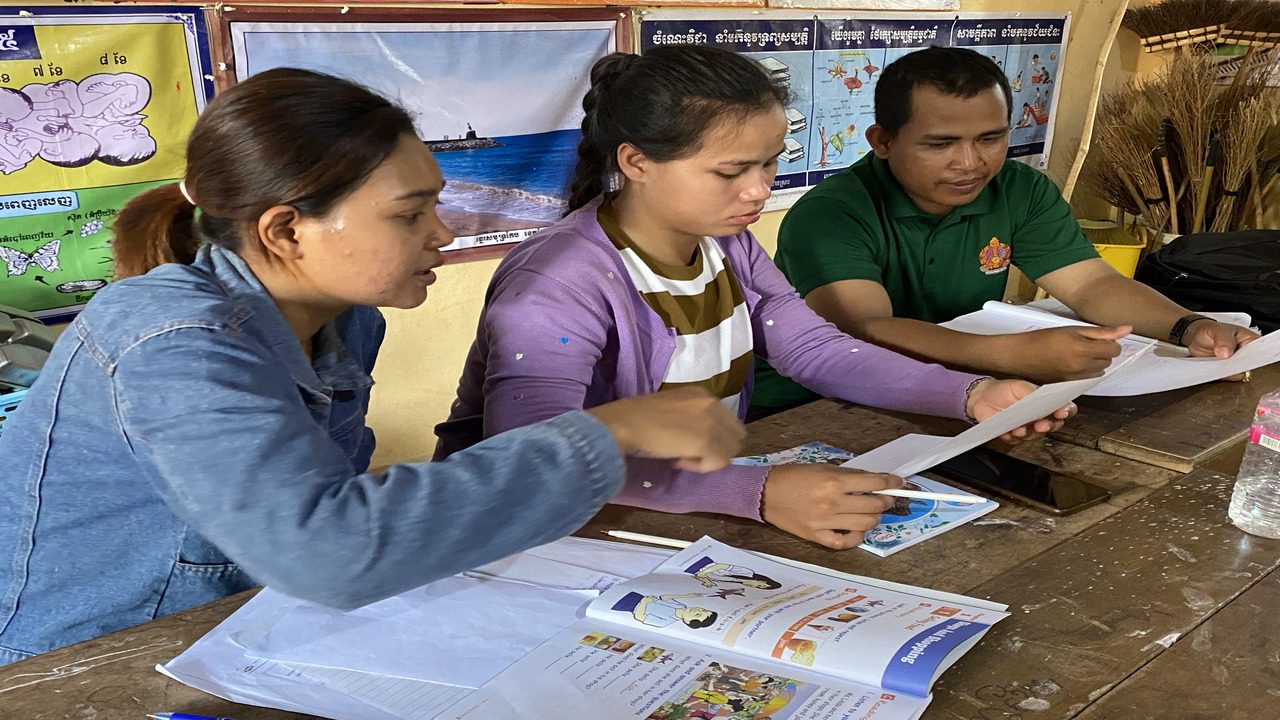

From CLT to TPA: The Discovery
An Empirical Observation, Not a Theoretical Leap
The shift from CLT to TPA was not a planned theoretical step. It was an empirical discovery that emerged from observing teachers over time.
As TDSO deepened its work in schools, coaches and programme staff began noticing a recurring pattern: teachers trained in CLT were changing how they taught all subjects, not just English. Techniques introduced for language teaching were appearing in mathematics, science, and Khmer literacy classes. Teachers described themselves as “better teachers overall” rather than simply “better English teachers.”
This was unexpected. TDSO had entered schools to improve English teaching. The broader transformation emerged organically from practice.
What TDSO Observed
To understand this phenomenon, TDSO undertook a systematic review of classroom observation notes, coaching records, teacher reflections, and lesson plans developed by participating teachers. Across these sources, several recurrent cross-subject practices emerged.
Structured interaction. Teachers increasingly used pair and group work not only for speaking English but also to solve mathematics problems, discuss science concepts, and brainstorm ideas in Khmer.
Scaffolding. Teachers structured learning sequences more deliberately: activating prior knowledge, modelling, guided practice, and finally independent use, regardless of subject.
Warm-up and engagement routines. Brief starter activities became a regular feature across subjects. Teachers used songs, games, simple questions, or quick review tasks to bring students into a learning mindset.
Use of real-life contexts and tasks. Teachers asked students to apply knowledge to familiar situations, talking about daily routines, local markets, family roles, or community issues, even in mathematics or science lessons.
Formative assessment and feedback. Questioning, observation, and quick checking strategies became more common. Teachers began adjusting lessons in response to students’ answers instead of following the textbook rigidly.
Facilitation rather than transmission. Teachers started to move from “telling” to “guiding,” asking more open questions and allowing students to think, discuss, and present.
These changes did not depend on English grammar or vocabulary. They reflected deeper pedagogical shifts in how teachers understood learning itself.
The Critical Insight
This pattern led TDSO to a critical insight: what was transferring from English to other subjects was not CLT as a language methodology, but the underlying pedagogical and professional learning principles.
The professional development process itself, which was experiential, practice-based, collaborative, and coached, seemed to be developing transferable teaching behaviours. Teachers who learned to facilitate communication in English were becoming teachers who facilitated learning in any subject.
Defining TPA
In response, TDSO began to articulate these principles explicitly. This resulted in the formulation of the Transferable Pedagogical Approaches (TPA) Framework.
TPA does not claim that all subjects should be taught “like a language,” nor does it suggest that one methodology fits every discipline. Instead, it acknowledges two realities: each subject requires its own disciplinary knowledge and pedagogical content knowledge; however, certain ways of structuring learning and supporting teacher development prove valuable across all subjects.
TPA is fundamentally informed by Communicative Language Teaching (CLT). This relationship is not merely historical but structural: CLT provides the theoretical foundation and practical mechanisms through which TPA operates.
CLT serves as the pedagogical approach that enables and facilitates the application of TPA across diverse learning contexts. The communicative principles that make CLT effective for language learning—practice-based learning, meaningful interaction, scaffolded support, and formative feedback—inform every aspect of TPA’s application across subjects. TPA represents an extension and generalisation of CLT principles rather than a departure from them.
This evolution from CLT to TPA was driven by evidence, not assumptions. Teachers consistently demonstrated that what they learned through CLT was transferable when properly supported through coaching, collaboration, and structured learning pathways.


Why Second Language Teaching Specifically?
Understanding the Foundation
Given that TPA emerged from second language teaching, an important question arises: why did CLT prove such fertile ground for discovering transferable principles? What is it about second language teaching that made these universal insights visible?
The answer has two parts: strategic reasons why English language teaching provides an effective entry point for educational development work in Cambodia, and pedagogical reasons why second language teaching reveals principles applicable across subjects
Strategic Reasons: Why English in the Cambodian Context
English offers specific advantages in the Cambodian context that make it the optimal foundation for developing transferable approaches.
Clear Need and High Stakes
English is critical for Cambodia’s economic development and integration into global markets. Tourism, hospitality, international business, technology sectors, and higher education all require English proficiency. Students, parents, and schools are highly motivated to improve English teaching. Government prioritises English in education policy. The demand for effective English teaching methodology is clear and urgent.
Cognitive Benefits of Bilingual Education
Research demonstrates that bilingual education offers profound cognitive benefits that enhance learning across all subjects. Students learning two languages develop enhanced executive functioning skills (superior planning and problem-solving), cognitive flexibility (adaptive thinking and creative approaches), metalinguistic awareness (deeper understanding of language systems), improved attention control (better focus whilst filtering distractions), and expanded working memory (greater capacity for complex cognitive tasks).
These cognitive advantages are not merely academic enhancements but fundamental improvements to students’ mental toolkit that benefit learning across mathematics, science, literacy, and all subjects. The cognitive flexibility developed through navigating between two linguistic systems creates lasting benefits that extend far beyond language proficiency itself. (read more)
English as Engagement Magnet
English attracts students and teachers because they find it interesting and relevant to their futures. Students see direct connections between English proficiency and their aspirations – travel, international careers, access to global media and technology. Teachers recognise that strong English teaching skills enhance their professional value and career opportunities.
This motivation creates exceptional engagement with professional development. Teachers invest deeply in improving their English teaching because they understand its importance to their students and themselves. This engagement provides fertile ground for introducing practice-based professional development methodologies that then prove transferable to other subjects.
Visible Quality Gap
Many English teachers lack strong English proficiency themselves. Traditional grammar-translation methods prove ineffective for communication. Students study English for years but cannot communicate effectively. The need for better methodology is obvious and urgent, creating clear motivation for professional development and making impact highly visible and measurable.
Bridge to Content Teaching
All subjects have language demands, regardless of the medium of instruction. Content teachers benefit from language-aware pedagogy even when teaching in Khmer. Understanding how students learn through language helps teachers support content learning in any context, providing a natural bridge from pure language teaching to strengthening content teaching through language awareness.
English as Additive, Not Subtractive
TDSO’s approach to English language teaching is fundamentally additive rather than subtractive. Students develop English proficiency whilst strengthening—not replacing—their Khmer language capabilities. This distinguishes TDSO’s work from colonial-era approaches where English was imposed at the expense of local languages and cultural identity.
Additive bilingualism recognises that students’ existing linguistic and cultural knowledge represents assets to build upon, not deficits to overcome. Khmer remains the foundation of students’ cognitive and cultural development. English adds additional capabilities without diminishing first-language proficiency or cultural connection.
This approach aligns with Cambodia’s development priorities for 2030 and 2050, which position English proficiency as essential for economic integration, international cooperation, and access to global knowledge whilst maintaining Khmer as the primary medium of education and national identity. TDSO’s methodology supports both objectives simultaneously.
Pedagogical Reasons: Eight Reasons Why Second Language Teaching is Optimal
Beyond these strategic advantages, second language teaching offers unique pedagogical characteristics that make it the optimal foundation for developing transferable approaches.
1. The Learning Process is Completely Visible
In second language learning, teachers can observe every step of development with unusual clarity. Unlike mathematics or science, where students bring varied and often invisible prior knowledge, language learning makes the developmental process transparent.
. They know no English at all. Every single step of progress is observable. Teachers see precisely how skills develop through practice, feedback, and time. Nothing happens automatically or unconsciously.
Contrast this with first language (Khmer): children arrive at school already speaking fluently. Much learning happened unconsciously at home. The full developmental process is hidden from teachers. In mathematics and science, students bring varied prior knowledge, making it difficult to isolate what specifically causes learning at any given moment.
While language learning makes progress visible, this does not mean students truly “start from zero.” Students bring rich linguistic capabilities in Khmer, cultural knowledge, communicative experience, and cognitive skills developed through their first language. These existing capabilities are assets that support second language acquisition.
The teacher’s task is not filling empty vessels but building bridges between students’ existing capabilities and the target language. Students’ first language knowledge accelerates rather than impedes English learning when teachers recognise and utilise these connections. This asset-based perspective transforms how teachers approach instruction: they draw on what students already know rather than treating them as blank slates.
2. Practice is Absolutely Non-Negotiable
You cannot learn English from lectures about English. Students must practice speaking, listening, reading, and writing. They must receive feedback. They must try again with corrections. There is no alternative pathway. No shortcut exists.
This necessity forced second language teachers to develop the most sophisticated practice-based methodologies of any discipline. It was not optional; it was survival.
In other subjects, students can sometimes appear to “learn” through passive observation or memorisation (though this proves ineffective long-term). In mathematics, teachers can demonstrate solutions whilst students watch, creating the illusion of learning without adequate practice.
3. Immediate Feedback is Built Into Communication
Communication either succeeds or fails immediately. Errors are obvious. If a student uses the wrong word or incorrect grammar, the message fails. Students need constant feedback to improve. Formative assessment is inherent to the communication process.
This develops exceptional feedback and assessment skills in second language teachers. In other subjects, feedback is often delayed (homework marked later, tests next week), resulting in less sophisticated feedback mechanisms.
4. Scaffolding Must Be Explicit and Systematic
Second language teachers must provide comprehensible input (not too difficult, not too easy), scaffold from supported practice to independent use, sequence learning logically from simple to complex, and gradually remove support as competence grows. The scaffolding process is conscious, deliberate, and visible.
In other subjects, scaffolding is often less systematic, less explicit, or invisible. Teachers may scaffold intuitively without understanding the underlying process.
5. Learner Agency is Essential
Students cannot be passive receivers in language learning. They must actively participate in communication. Motivation dramatically affects outcomes. Relevance to learners’ lives matters enormously. Social interaction accelerates learning. Learner-centred approaches developed out of necessity in CLT.
In other subjects, teacher-centred transmission models remain common, with less emphasis on student agency and active participation.
6. Errors are Productive Learning Steps
In language learning, errors are necessary. Students try to communicate before they can do so perfectly. Making mistakes is how learning happens. “Interlanguage” theory describes how learners build progressive approximations towards the target language. Teachers distinguish errors requiring immediate correction from natural developmental stages. Growth mindset is essential.
In other subjects, errors are often seen primarily as failure rather than as productive learning steps, with less sophisticated understanding of developmental progressions.
7. The Research Base is Exceptionally Strong
Second Language Acquisition (SLA) research provides decades of rigorous international study, established theories (Krashen’s Input Hypothesis, Swain’s Output Hypothesis, Long’s Interaction Hypothesis), well-documented developmental sequences, proven methodologies (CLT, TBLT, CLIL), and clear understanding of what works and why.
In other subjects, pedagogical research is often less developed or less focused on precisely how skills develop through practice.
8. Language is the Medium for All Learning
This is the key insight that makes second language pedagogy universally transferable: every subject requires language, every teacher teaches through language, every student learns through language. Understanding how language works means understanding how learning works.
Mathematics teachers must address language demands of word problems. Science teachers must support students reading scientific texts. TVET instructors must teach technical vocabulary and workplace communication. Every teacher is a language teacher, whether they recognise it or not.
The Bottom Line
Second language teaching provided TDSO with a uniquely clear window into how learning happens. The characteristics of language learning, particularly its visibility, its dependence on practice, and its requirement for interaction, made pedagogical principles observable that remain hidden in other subjects. This clarity enabled TDSO to identify, articulate, and systematise the transferable approaches that now form the TPA framework.
Strategically, English provides the motivation, engagement, and relevance that makes professional development work effective in the Cambodian context. Pedagogically, second language teaching makes the learning process uniquely visible, requires sophisticated practice-based approaches out of necessity, and reveals principles that strengthen teaching across all subjects.
Systematising the TPA Framework
From Insight to Methodology
Recognising that CLT principles transfer is one thing. Systematising those principles into a coherent, replicable methodology for teacher professional development across subjects is another.
This systematisation process involved documenting transferable principles clearly (what specifically transfers from CLT?), testing across contexts (do these principles work in mathematics, science, TVET subjects?), adapting for different subjects (how do principles apply to subject-specific pedagogy?), creating implementation structures (how do we operationalise these principles?), measuring effectiveness (what evidence shows this works?), and refining based on feedback (how do we improve continuously?).
The TPA Framework: Six Core Principles
Through this process, TDSO developed the TPA (Transferable Pedagogical Approaches) framework, comprising six core principles:
Principle 1: Practice-Based Learning
Just as you cannot learn English from lectures about English, teachers cannot learn to teach effectively from lectures about teaching. Professional learning must centre on teachers’ actual classroom practice, with opportunities to try new approaches, receive feedback, and refine their teaching.
Teachers in the EPST programme confirm this principle. Through practice-based training, they developed specific competencies including effective vocabulary teaching, simplified language chunks, conversation-based instruction, and gamification techniques. One teacher described the approach: “I gained new skills, like how to teach young learners, how to teach using communicative language teaching, gamification, and other fun activities.”
These were not abstract concepts but practical methods teachers immediately applied: games such as “jump and read”, “whisper game”, and “slap the board” created engaging learning environments. Teachers implemented conversation-based teaching through role-play, pair work, and group activities that enabled students to apply vocabulary to their daily routines.
Principle 2: Peer Collaboration
Just as language learners benefit from interacting with peers, teachers develop professionally through structured peer collaboration. Working together to solve common challenges, observing each other teach, planning collaboratively, and building communities of practice proves remarkably powerful.
Principle 3: Systematic Progression
Just as language proficiency develops through clear stages, teaching expertise develops systematically over time. TPA provides structured pathways from foundation through development to mastery, with recognition at each stage.
Principle 4: Subject-Specific Focus
Just as teaching English differs from teaching Khmer (due to different phonology, grammar, and vocabulary), teaching mathematics differs from teaching science. Generic teaching skills prove insufficient. Teachers need pedagogical content knowledge specific to their subject. TPA addresses subject-specific pedagogical needs whilst maintaining methodological coherence.
Principle 5: Continuous Coaching and Support
Just as language learners need ongoing feedback to improve, teachers require continuous coaching and support. Not one-off workshops, but sustained accompaniment by trained coaches who understand classroom realities and provide practice-based feedback.
The value of ongoing coaching is evident in teacher experience. When teachers encountered implementation challenges, particularly students unfamiliar with active learning approaches, coaching support proved essential. As one teacher noted: “The coaches were so supportive. When my coach noticed that I had problems in the classroom, they jumped in for help.”
Another teacher highlighted how feedback enabled continuous improvement: “The feedback from coaches and trainers, together with self-study, is crucial for overcoming challenges.” This sustained support transformed initial difficulties into lasting competence.
Principle 6: Evidence-Based Refinement
Just as CLT evolved through research and evidence, TPA continuously measures impact, gathers feedback, analyses effectiveness, and refines approaches based on what works. The framework evolves through evidence, not ideology.
TDSO’s Quality Assurance Team conducts systematic impact evaluations using mixed methods: semi-structured teacher interviews and pre/post-testing with statistical analysis. The 2025 EPST evaluation demonstrated that interventions significantly enhanced English language outcomes across vocabulary (mean improvement from 12.56 to 14.53), grammar (7.10 to 8.44), reading (6.52 to 8.05), and speaking (10.23 to 18.02). All improvements reached statistical significance (p < .001).
This evidence enables programme refinement. For instance, the evaluation identified that speaking skills showed particularly strong gains, validating the emphasis on communicative practice. It also revealed variation between schools, informing targeted support strategies.
The Three-Phase Implementation Model
TPA operates through three interconnected phases:
Phase 1: Foundation (Intensive Initial Training)
Teachers engage in intensive training introducing the TPA methodology, subject-specific core concepts, practice-based learning approaches, and peer collaboration structures. This provides solid grounding for ongoing development.
Phase 2: Supported Implementation (Continuous Professional Development)
Teachers receive ongoing coaching and support as they implement new approaches in their classrooms. Regular peer collaboration sessions, classroom-based coaching, and continuous feedback enable sustained improvement.
Phase 3: Advanced Development and Leadership
Experienced teachers develop advanced expertise and leadership capacity, eventually becoming coaches and mentors for other teachers. This builds sustainable, self-improving systems.
The Three Dimensions of TDSO's Work
TDSO’s work operates across three interconnected dimensions, each building on the foundation of CLT expertise whilst extending the impact of transferable pedagogical approaches.
Dimension 1: Pure Language Teaching
English language teaching remains TDSO’s most extensive programme, supporting over 800 teachers. This remains TDSO’s core expertise and the foundation from which TPA emerged. The depth of experience in CLT implementation, the evidence base built through years of practice, and the sophisticated understanding of how language teaching works provide the intellectual foundation for all TDSO’s work.
This dimension continues to evolve. TDSO refines CLT implementation approaches, develops resources and materials, trains new cohorts of English teachers, and builds coaching capacity within the education system. The English programme is not simply maintained – it continuously improves based on evidence and feedback.
Dimension 2: Content and Language Integration
Supporting content teachers to address the language demands of their subjects, particularly where English is the medium of instruction. This includes mathematics and science, where both content pedagogy and language-aware teaching are essential.
This dimension recognises a crucial reality: students cannot learn content without understanding the language in which that content is taught. A mathematics teacher teaching in English must address both mathematical concepts and the language through which those concepts are expressed. Word problems require linguistic comprehension as well as mathematical reasoning. Scientific texts use specialised vocabulary and grammatical structures that must be explicitly taught.
TDSO supports content teachers to become language-aware in their teaching: identifying language demands in their subject, scaffolding language alongside content, supporting students to read, write, and discuss in the language of instruction, and assessing both content understanding and language development.
This work bridges pure language teaching and content teaching, demonstrating how language pedagogy strengthens content learning.
Dimension 3: Transferable Pedagogical Approaches Across Subjects
Applying TPA methodology to strengthen teaching across all subjects: mathematics pedagogy, science pedagogy, IT skills for educators, and emerging work in TVET contexts (hospitality, technology education). This represents the full realisation of transferable principles.
In this dimension, TDSO works with teachers who may teach entirely in Khmer with no English component. The focus is purely on strengthening pedagogical practice using the principles derived from CLT: practice-based learning, peer collaboration, systematic progression, continuous coaching, and evidence-based refinement.
A mathematics teacher learns mathematical pedagogy through the same professional development methodology that proved effective for English teachers. The content differs entirely (fractions, algebra, geometry rather than grammar, vocabulary, communication), but the methodology for professional learning remains consistent.
This work demonstrates that TPA is genuinely transferable – not dependent on language teaching content but applicable to any subject when adapted appropriately for subject-specific pedagogical needs.
TPA in Practice: A TVET Example
Consider how CLT-informed TPA applies to hospitality training. A TVET instructor teaching food service procedures might traditionally demonstrate techniques whilst students watch, then have students practice individually whilst the instructor corrects errors.
Using TPA principles informed by CLT, the same content transforms: students work in pairs role-playing server and customer interactions (practice through interaction), the instructor scaffolds from simple greeting scripts to handling complex orders (systematic scaffolding), peer feedback helps students refine their communication (formative assessment), and authentic scenarios such as handling complaints or dietary requirements replace artificial drills (authentic tasks). The instructor facilitates rather than lectures.
The hospitality content is entirely different from English grammar, but the pedagogical approach—derived from CLT principles—proves equally effective. Students develop practical competence through meaningful practice, not through passive observation.
The Interconnection
These three dimensions are not separate programmes but interconnected aspects of a coherent system. Language teaching expertise informs content and language integration, revealing transferable principles applicable across all subjects.
Teachers who experience professional development in one dimension often engage with others. An English teacher supported through Dimension 1 may also teach mathematics and benefit from Dimension 3 support. A science teacher working on content and language integration (Dimension 2) develops pedagogical approaches applicable to their science teaching more broadly (Dimension 3).
This interconnection strengthens TDSO’s work. Insights from one dimension inform others. Evidence of effectiveness in one area validates approaches in others. The system is coherent whilst allowing appropriate specialisation for different subjects and contexts.
Implementation Challenges and Solutions
TPA acknowledges that implementing new pedagogical approaches involves real challenges. Transparency about these challenges, and the strategies that address them, strengthens rather than weakens the framework’s credibility.
Common Implementation Challenges
Teachers implementing CLT-based methods initially face practical obstacles. Students unfamiliar with active learning may struggle to follow new instructions. Teachers with developing English proficiency must balance language exposure with comprehension. Some students resist participation due to shyness or unfamiliarity with interactive methods.
As one teacher described: “At first, students could not follow my instructions as they were never exposed to new learning environments.” Another noted: “It was a bit difficult for me due to my limited competence in English and a lack of teaching techniques. Some students were shy, so they did not want to get involved with the activities.”
How TDSO's Approach Addresses These Challenges
TDSO’s methodology addresses these challenges through systematic support. Teachers learn to scaffold the transition: initially using some Khmer to ensure understanding, then gradually increasing English exposure as students develop confidence. As one teacher explained: “At first, I did not really use all English for teaching. I also used some Khmer to ensure that they could understand. Later, I tried to expose them to the English language little by little till they were able to understand my instructions.”
Advance lesson planning enables teachers to anticipate difficulties. Regular coaching provides real-time problem-solving when challenges emerge in the classroom.
Motivational strategies prove essential. Teachers encourage students to use English even when making mistakes, building confidence through supported practice rather than error correction. One teacher described this approach: “I helped students step-by-step by encouraging them to use or speak English, though they made mistakes, thereby enhancing students’ confidence.”
Contextual Factors
The 2025 EPST evaluation revealed that results varied between the two participating schools, with students at Prasat Primary School outperforming those at Prey Chruk Primary School at both pre- and post-test stages. This variation highlights the importance of school-level conditions such as teacher language proficiency, classroom organisation, leadership support, and student prior knowledge.
These differences reinforce that implementation models need to be adaptive, not uniform. Context-sensitive approaches and differentiated coaching enable TPA to work effectively across diverse school environments.
Conditions for Success
To achieve sustained impact, TPA requires certain enabling conditions:
- Supportive school leadership that values professional development
- Protected time for teacher collaboration and peer learning
- Professional trust rather than fear-based accountability systems
- Integration with curriculum frameworks and assessment systems
- Investment in developing coaches and mentors
- Recognition and valuing of teacher expertise
These conditions are not luxuries—they are prerequisites for sustainable improvement. Where these conditions are weak, TDSO works with school leaders and education authorities to strengthen them as part of the implementation process.
The Importance of Developmental Accountability
TPA embraces accountability whilst reframing it developmentally. Rather than accountability defined solely through standardised testing or external inspection, TPA promotes authentic accountability: to students whose learning must genuinely improve, to communities whose children deserve quality education, and to Cambodia’s future workforce and society.
This developmental approach reclaims accountability from purely compliance-based interpretations. Teachers are accountable for continuous professional growth. Schools are accountable for supporting that growth. TDSO is accountable for providing effective methodology and measuring genuine impact.
Evidence-based refinement (TPA Principle 6) operationalises this accountability. Regular assessment of student outcomes, systematic observation of teaching practice, and honest evaluation of programme effectiveness ensure that accountability produces improvement rather than merely documentation.
Transferable Problem-Solving
The solutions teachers develop through coaching and peer collaboration become transferable competencies. Problem-solving approaches that work for English teaching, such as scaffolded introduction of new methods, strategic use of first language, and building student confidence through supported practice, apply equally when implementing active learning approaches in mathematics, science, or other subjects.
TDSO's Competitive Advantage
What Makes TPA Different
Many organisations provide teacher training. What makes TDSO’s TPA approach distinctive?
First, it emerged from deep specialist expertise. TPA developed through intensive CLT work rather than from generic educational theory. This grounding in proven methodology, backed by decades of research, provides intellectual credibility that abstract frameworks cannot match.
Second, it is practice-based by design, mirroring how effective learning actually happens. Teachers develop competence through doing, receiving feedback, and refining practice, not through lectures about teaching. This alignment with how humans actually learn makes TPA fundamentally more effective than transmission-based training models.
Third, it provides systematic, sustained support, not one-off workshops. Teachers receive continuous coaching, engage in ongoing peer collaboration, and develop expertise through clear progression pathways. This sustained engagement produces genuine transformation rather than temporary enthusiasm.
Fourth, it has documented methodology. TPA is not vague advice but a clear framework with specific principles, implementation structures, and progression pathways. This documentation enables replication, quality control, and continuous refinement based on evidence.
Fifth, it demonstrates measurable impact on teaching practice and student learning. TDSO tracks changes in classroom practice, documents teacher development progression, and measures student learning outcomes. The 2025 EPST evaluation showed statistically significant improvements in student English proficiency, with effect sizes of 0.67 for written skills and 0.93 for speaking skills: evidence that the approach produces real learning gains.
Sixth, it builds sustainable systems. By training teachers to become coaches and developing capacity within government structures, TPA creates self-improving systems that continue functioning after external support concludes. This represents genuine sustainability rather than dependency on external organisations.
The Competitive Insight
Understanding how students learn a second language through CLT reveals fundamental truths about how skills develop through practice, scaffolding, feedback, and sustained engagement. This is TDSO’s core insight and competitive advantage.
Other organisations may understand mathematics pedagogy or science teaching or vocational education. TDSO understands how teachers develop expertise across subjects because we understand principles underlying skill development: principles made visible through second language teaching.
The Transformation Beyond English
The remarkable transformation of teachers extends beyond technique acquisition to fundamental professional development. Teachers in the EPST programme described shifting from traditional methods (students memorising and repeating words) to learner-centred approaches where students actively participate in communication.
One teacher articulated this transformation: “Teaching was traditional because students were asked to memorise or repeat the words.” After training, the same teachers reported: “Students were more engaged and active, and they were having fun.”
This shift produced measurable student outcomes. Students demonstrated increased engagement, improved motivation for English learning, and enhanced performance on assessments. As teachers noted: “Students are more interested in learning than before. They were happier to study English. They were not bored with studying English like before.”
The professional development also built teacher resilience. When facing challenges, teachers developed adaptive strategies: using Khmer strategically whilst gradually increasing English exposure, systematic lesson planning, and reflection-informed practice. These problem-solving capabilities transfer across subjects.
Documented Property
TPA represents genuine methodology: documented approaches with clear theoretical foundations, proven implementation structures, and evidence of effectiveness. This documentation distinguishes TDSO’s work from generic teacher training.
The journey from CLT to TPA is traceable. The principles are explicit. The implementation model is clear. The evidence base is substantial. This intellectual rigour enables TDSO to work with government partners, international organisations, and institutional funders who require demonstrated effectiveness and replicable methodology
Cambodia-Rooted, Globally Applicable
TPA emerged from intensive work in Cambodian public schools, addressing Cambodian educational challenges with Cambodian teachers. It is authentically rooted in Cambodian context, not imported theory imposed on local reality.
Yet the principles are widely applicable. Practice-based professional development, peer collaboration, systematic progression, continuous coaching, and evidence-based refinement work in any education system because they align with how humans develop expertise.
This combination, deep Cambodian roots with transferable methodology, positions TDSO uniquely. We understand Cambodian education intimately whilst offering approaches applicable beyond Cambodia should opportunities for international partnership emerge.
From CLT to TPA: A Journey of Evidence and Insight
TDSO’s TPA framework systematises proven principles from Communicative Language Teaching into a transferable methodology for teacher professional development across subjects. It is not abstract theory but documented methodology emerging from intensive practice, validated through evidence, and refined through continuous application.
The journey from supporting English teachers with CLT to developing a transferable framework applicable across all subjects reflects a profound insight: effective professional development methodology transcends subject boundaries because it aligns with principles of how humans develop expertise through practice.
TPA represents TDSO’s documented intellectual property, a methodology grounded in the proven principles of Communicative Language Teaching, adapted to Cambodian contexts, validated through rigorous evaluation, and designed for scalable, sustainable impact across subjects and school systems. This is the foundation upon which TDSO operates as Cambodia’s reference organisation for in-service teacher professional development.
Key Evidence: EPST Programme Impact Summary
Programme: English for Public School Teachers (EPST), 40 weeks (120 hours)
Location: Prey Chruk and Prasat Primary Schools, Pouk District, Siem Reap Province
Participants: 21 teachers, 99 students (Grade 5)
Evaluation: August 2025, conducted by TDSO Quality Assurance Team
Student Learning Outcomes
Skill Area | Pre-Test Mean | Post-Test Mean | Improvement |
Vocabulary (20 pts) | 12.56 | 14.53 | +1.97 |
Grammar (15 pts) | 7.10 | 8.44 | +1.34 |
Reading (15 pts) | 6.52 | 8.05 | +1.53 |
Speaking (50 pts) | 10.23 | 18.02 | +7.79 |
Total (100 pts) | 36.40 | 49.04 | +12.64 |
Statistical Significance
All improvements reached statistical significance (p < .001):
- Written skills: Cohen’s d = 0.67 (moderate to large effect)
- Speaking skills: Cohen’s d = 0.93 (large effect)
Teaching Practice Changes
Teachers reported implementing:
- Game-based learning (jump and read, whisper game, slap the board, snowball)
- Communicative approaches (role-play, pair work, group work)
- Warm-up activities (songs, games)
- Conversation-based teaching reflecting daily routines
Source: Impact Measurement: English for Public School Teachers (EPST) Training Program, TDSO Quality Assurance Team, August 2025