
Why In-Service Teacher Development
Supporting practising teachers to build sustainable capacity where it matters most
TDSO’s focus on in-service teacher professional development represents a strategic choice based on where educational impact can be achieved most effectively. Whilst pre-service teacher education prepares future teachers, in-service development works with the teachers who are in classrooms today, teaching Cambodia’s students now.
This distinction matters profoundly. The case for prioritising in-service development rests on six interconnected realities of how teacher professional development actually works.
Immediate Classroom Impact
The Reality
Cambodia has over 100,000 teachers currently working in public schools. These teachers are teaching students today. Pre-service education prepares future teachers, but those teachers will not enter classrooms for years, and when they do, they will represent only a small fraction of the teaching workforce annually.
The Mathematics of Impact
Consider pre-service teacher education: training 2,000 new teachers per year, with each eventually teaching 40 students, represents 80,000 students impacted by newly trained teachers. However, those teachers will not enter classrooms for four years, meaning students today receive no benefit. More critically, 2,000 new teachers represent less than 2% of Cambodia’s teaching force of over 100,000. At this rate, replacing the entire teaching workforce with newly trained teachers would take 50 years.
Compare this with in-service development: TDSO currently supports 2,000 teachers per year, with plans to scale to 10,000 annually through capacity building at PTTCs. Each of these teachers is already teaching 40 students today. The impact is immediate – 80,000 to 400,000 students benefit this year, not in four years’ time. These same teachers continue teaching for another 10, 20, or 30 years, multiplying the impact across their remaining careers.
The choice is stark: wait 50 years for gradual workforce replacement through pre-service education, or improve teaching practice now for the teachers already in classrooms, benefiting students immediately whilst building sustainable capacity for continuous professional growth.
Direct Application in Current Classes
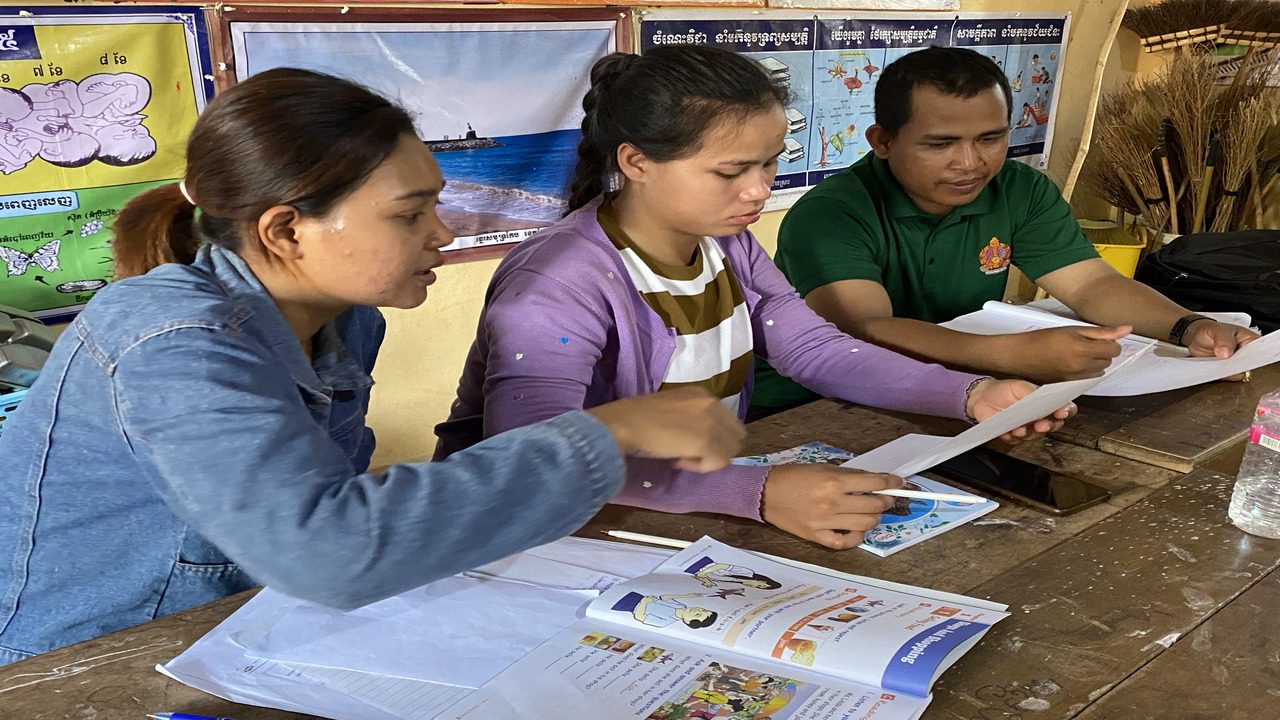
When in-service teachers learn a new pedagogical approach, they implement it with their current students the next day. Results are immediate and visible. Teachers see whether students engage more effectively, understand concepts more clearly, or develop skills more rapidly. This immediate application creates a powerful motivation for continued professional growth – teachers experience directly how improved practice benefits their students.
Existing Teaching Context
Authentic Practice, Not Simulation
Teaching is a practice-based profession. You cannot learn to teach effectively through lectures about teaching, just as you cannot learn to drive through lectures about driving or learn to swim through lectures about swimming. Teaching competence develops through doing teaching, receiving feedback, refining practice, and accumulating experience.
Pre-service teacher education faces an inherent limitation: student teachers are not yet teaching. They can observe teaching, they can practice teaching in brief placements, but they are not responsible for classrooms. The learning context is simulated, not authentic.
In-service teachers bring their actual classroom practice to professional development. They try new approaches with their real students, observe what works and what does not, receive feedback on their actual teaching, and refine their practice based on genuine results. The learning is grounded in authentic practice, not simulated contexts.
Real Problems Require Real Solutions
In-service teachers face genuine challenges daily: large class sizes, diverse student readiness, limited resources, examination pressures, and curriculum demands. Professional development that addresses these actual challenges proves immediately relevant and applicable.
Pre-service education must address anticipated challenges that student teachers will encounter eventually. The learning remains somewhat hypothetical – how to manage a large class, how to differentiate instruction, how to assess effectively – because the student teacher is not yet managing their own classroom.
Context-Specific Adaptation
Teaching in a rural school with 60 students per class and minimal resources differs profoundly from teaching in a well-resourced urban school with 30 students. In-service teachers know their specific context intimately. Professional development can be adapted to address their particular circumstances, making it immediately practical and applicable.
Pre-service education must prepare student teachers for various possible contexts, resulting in more generic preparation that may not fit any specific context particularly well.
The Feedback Loop
In-service teachers have immediate access to the most important feedback mechanism: student learning. They can see whether new approaches work by observing student engagement, understanding, and achievement. This creates a rapid cycle of implementation, observation, and refinement that is simply not available in pre-service contexts where student teaching placements are brief and intermittent.
Adult Learners with Experience
Professional Expertise as Foundation
In-service teachers are not novices learning a profession from scratch. They are experienced professionals developing advanced expertise. They understand classroom dynamics, have established relationships with students, know their curriculum, and have accumulated practical knowledge through years of teaching. This experience provides essential foundation for sophisticated professional development.
Pre-service students lack this experiential base. They are learning what teaching is whilst simultaneously learning how to teach. In-service teachers already know what teaching is – they are refining how to teach more effectively.
Self-Directed Professional Learning
Adult learners approach professional development differently from students in initial training. In-service teachers identify specific challenges in their practice, seek solutions to problems they face daily, evaluate new approaches based on practical effectiveness, and integrate learning into their existing professional knowledge. They are self-directed learners with clear motivation rooted in improving their actual work.
This creates fundamentally more effective professional development. Teachers are not learning because they are told to, but because they recognise the value for their practice and their students.
Sophisticated Professional Dialogue
Experienced teachers can engage in sophisticated professional dialogue that would be impossible with pre-service students. They can discuss subtle pedagogical distinctions, compare different approaches based on actual implementation, analyse why particular strategies work in specific contexts, and contribute insights from their own practice. Professional development becomes collaborative knowledge-building, not one-way transmission of information.
Faster Skill Development
Because in-service teachers already possess foundational teaching competence, they develop new skills more rapidly. They are not learning everything simultaneously but adding specific capabilities to existing expertise. A teacher with 10 years’ experience learning formative assessment techniques can implement them immediately and effectively because they already understand classroom management, student engagement, and curriculum content. Pre-service students must develop all these competencies simultaneously, slowing the learning process considerably.
School-Based Support Systems
Established Professional Communities
In-service teachers work within established schools that provide existing structures for professional collaboration. They have colleagues teaching the same subjects, school leadership providing support and accountability, departmental structures enabling subject-specific collaboration, and established routines allowing time for professional development activities. These school-based structures are essential infrastructure for effective professional learning.
Pre-service students lack these established professional communities. They are preparing to join schools, not yet part of functioning school systems.
Peer Learning and Collaborative Problem-Solving
Experienced teachers learning together create extraordinarily powerful professional development contexts. They share common challenges, understand classroom realities, bring diverse experience and approaches, and can problem-solve collaboratively based on actual practice. When mathematics teachers work together on developing formative assessment in mathematics, they share subject-specific insights that generic training cannot provide.
These peer learning structures prove more sustainable than external training. Teachers continue collaborating after formal programmes end, creating ongoing mechanisms for professional growth embedded within schools themselves.
Subject-Specific Communities of Practice
In-service development enables the formation of subject-specific communities of practice: mathematics teachers working together on mathematical pedagogy, science teachers addressing laboratory teaching challenges, English teachers developing communicative language teaching approaches. These communities share specialised knowledge and tackle subject-specific pedagogical challenges that generic teacher training cannot address adequately.
Pre-service programmes typically group student teachers by cohort rather than subject specialisation, limiting opportunities for deep subject-specific peer learning.
Integration with School Leadership
School leaders play crucial roles in effective professional development. They provide time for teacher collaboration, create expectations for professional growth, support teachers implementing new approaches, and sustain focus on instructional improvement. In-service development works with these school leaders directly, ensuring that professional development initiatives receive necessary support and become embedded in school culture rather than remaining isolated training events.
Sustained Follow-Up Possible
Beyond One-Off Workshops
Effective professional development requires sustained engagement over time. Teachers need opportunities to try new approaches, encounter challenges, receive feedback, refine their practice, and gradually build competence. This cannot happen in single workshop events but requires continuous support extending over months or years.
In-service development enables this sustained follow-up because teachers remain in their schools throughout the professional development process. Coaches can return to classrooms repeatedly, teachers can engage in ongoing peer collaboration, and professional development programmes can extend across multiple school terms.
Classroom-Based Coaching
The most effective professional development includes classroom-based coaching where trained coaches observe teachers’ actual practice, provide specific feedback, model effective approaches, and support teachers implementing new techniques. This coaching proves far more effective than workshop training alone because it addresses real challenges in authentic contexts.
In-service teachers remain accessible for this coaching. Coaches can visit classrooms, observe teaching, and provide feedback based on actual practice. Pre-service students have no permanent classrooms to receive this sustained coaching support.
Iterative Refinement
Professional growth happens through cycles of implementation and refinement. Teachers try a new approach, observe results, adjust based on feedback, try again with modifications, and gradually develop mastery. This iterative process requires time and sustained support.
In-service development accommodates this iterative refinement. Teachers implement new practices, return to peer groups or coaches with specific questions (“I tried this approach and here is what happened – how should I adjust?”), receive guidance, and continue refining. This cycle accelerates learning dramatically compared to one-time training events.
Long-Term Mentoring Relationships
Sustained professional development creates mentoring relationships between experienced teacher-leaders and developing teachers. These relationships provide ongoing support, build professional confidence, and create pathways for continuous growth. Mentors understand their mentees’ specific contexts, challenges, and strengths, enabling highly personalised support that generic training cannot provide.
System Integration and Sustainability
Scale and Reach
Cambodia’s education system includes over 100,000 teachers already working in schools. Improving their practice creates system-wide impact. Pre-service education, by contrast, affects only the new teachers entering the system each year – perhaps 2,000 to 3,000 individuals annually.
The mathematics are clear: even modest improvements in existing teachers’ effectiveness, when multiplied across the entire teaching force, produce far greater system impact than excellent pre-service preparation for the small number of new teachers entering annually.
Direct Integration with Government Structures
In-service professional development works directly with Ministry of Education structures: Provincial Teacher Training Centres, District Offices of Education, school clusters, and school leadership. This direct integration ensures that professional development aligns with government priorities, supports implementation of national curriculum, strengthens existing education structures rather than creating parallel systems, and builds capacity within government institutions themselves.
This integration creates genuine systemic change. Professional development becomes embedded in how the education system functions, not an external intervention dependent on donor funding.
Building Internal Capacity
In-service development that trains existing teachers to become coaches and professional development leaders builds permanent capacity within the education system. These teacher-leaders become ongoing resources for their schools and districts, providing sustained support long after external programmes conclude.
This represents genuine sustainability: professional development capacity remains within the system, owned by the Ministry of Education and by teachers themselves, rather than depending on external organisations indefinitely.
The Multiplier Effect
Cost-Effectiveness and Return on Investment
In-service professional development represents exceptional value for investment. Supporting an existing teacher to improve their practice benefits students immediately and continues benefiting students throughout that teacher’s remaining career. The cost per student impacted, calculated over time, is remarkably low.
Pre-service education incurs substantial costs per teacher trained, and the return on that investment is delayed until the teacher secures a position and extends over their future career. Additionally, some proportion of pre-service graduates never enter teaching or leave the profession early, meaning the investment yields no return.
Targeted Strategic Investment
In-service development allows strategic targeting of investment: focusing on schools with greatest need, prioritising subjects where teaching quality is weakest, supporting teachers who demonstrate commitment to professional growth, and building capacity in regions where it will have most impact. Pre-service education cannot target investment as precisely – teacher education institutions prepare teachers who may teach anywhere, in any subject, or may not teach at all.
The Strategic Choice
TDSO’s focus on in-service teacher professional development reflects clear analysis of where impact can be achieved most effectively. The existing teaching force represents both the immediate opportunity and the practical necessity for improving education quality in Cambodia.
This is not to diminish the importance of pre-service teacher education. Strong initial preparation matters. But given limited resources and the urgent need to improve teaching quality for students in classrooms today, in-service professional development offers demonstrably greater impact per investment and creates sustainable systems for continuous teacher growth.